

Faucet Polishing Process Guide: How High-Quality Surface Finishing Is Achieved
Faucet Polishing Process Guide: How High-Quality Surface Finishing Is Achieved in Modern Faucet Manufacturing
In the global sanitary ware industry, faucet surface quality is one of the most important factors influencing purchasing decisions from wholesalers, importers, and construction project contractors. While internal structure determines durability, the polishing process determines appearance, corrosion resistance, and perceived value.
For B2B buyers, understanding how faucets are polished helps evaluate factory capability, reduce quality risks, and ensure consistent supply for large-scale projects such as hotels, residential developments, and commercial buildings.
This guide explains the complete faucet polishing process, from raw brass or stainless steel casting to mirror finishing and surface treatment, so you can better assess supplier manufacturing standards.
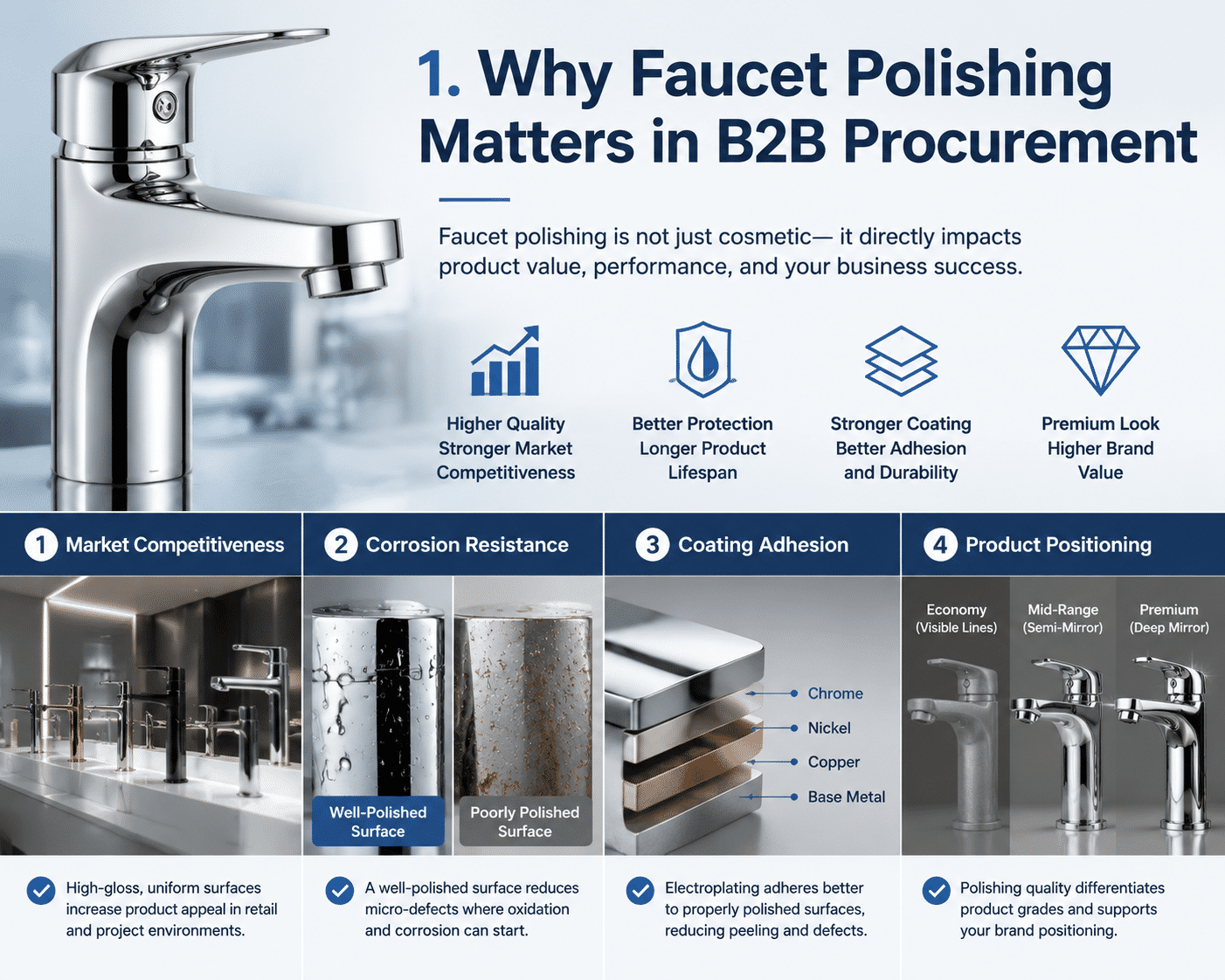
1. Why Faucet Polishing Matters in B2B Procurement
In engineering and wholesale procurement, faucet polishing is not just cosmetic—it directly impacts:
1) Market Competitiveness
High-gloss, uniform surfaces increase product appeal in retail and project installation environments.
2) Corrosion Resistance
A well-polished surface reduces micro-defects where oxidation and corrosion can start.
3) Coating Adhesion
Electroplating (chrome, nickel, PVD, matte black) adheres better to properly polished surfaces.
4) Product Positioning
Polishing quality differentiates:
· Economy-grade faucets (visible polishing lines)
· Mid-range products (semi-mirror finish)
· Premium products (deep mirror + multi-layer buffing)
For importers and contractors, inconsistent polishing often leads to complaints, returns, and long-term reputation risks.
2. Raw Material Preparation Before Polishing
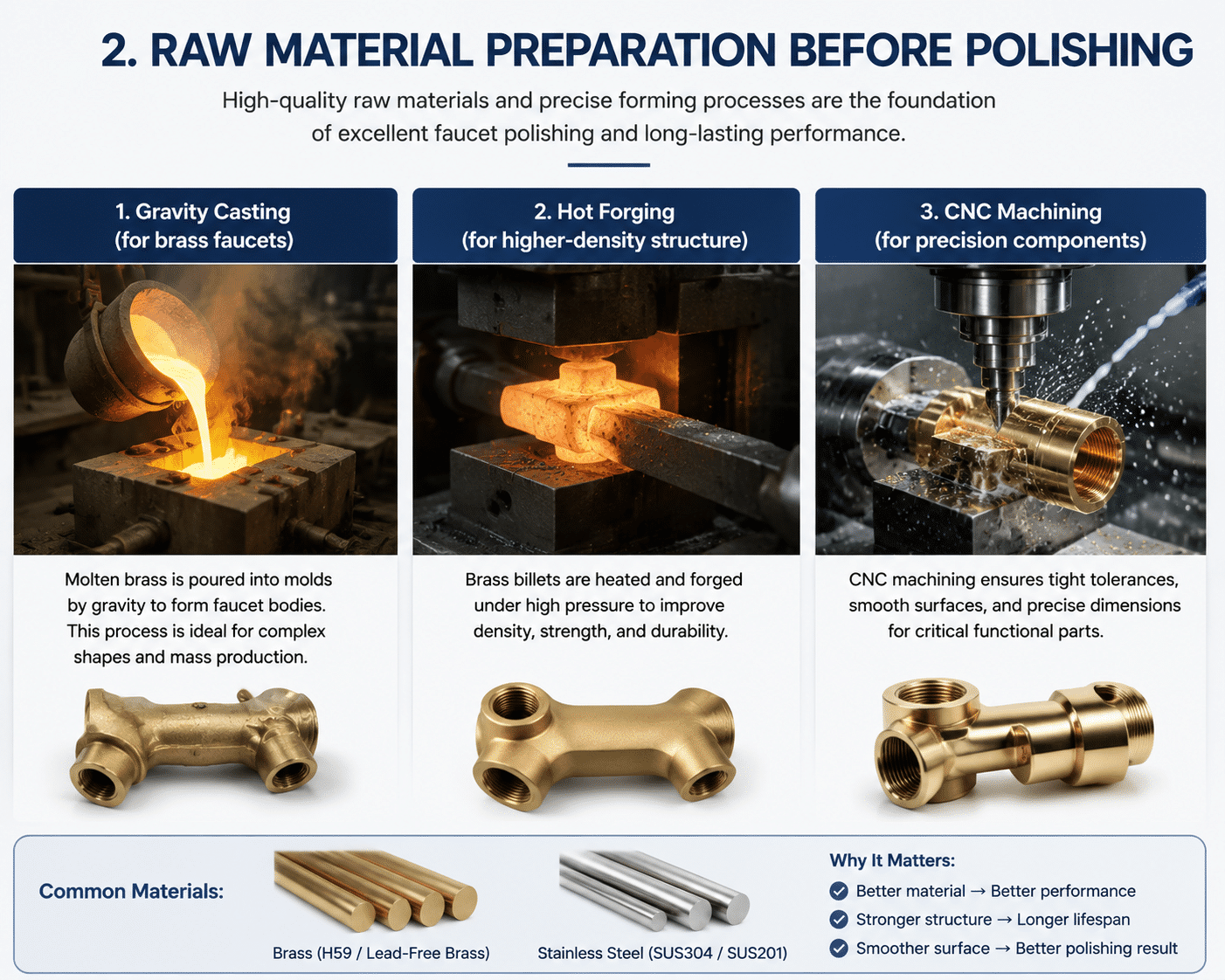
Before polishing begins, faucet bodies are formed through processes such as:
· Gravity casting (for brass faucets)
· Hot forging (for higher-density structure)
· CNC machining (for precision components)
Common materials include:
· Brass (H59 / lead-free brass)
· Stainless steel (SUS304 / SUS201)
After forming, the surface still contains:
· Mold parting lines
· Burrs and flash
· Sand casting texture
· Machining marks
These imperfections must be removed in multiple polishing stages.
3. Initial Grinding (Rough Surface Removal)
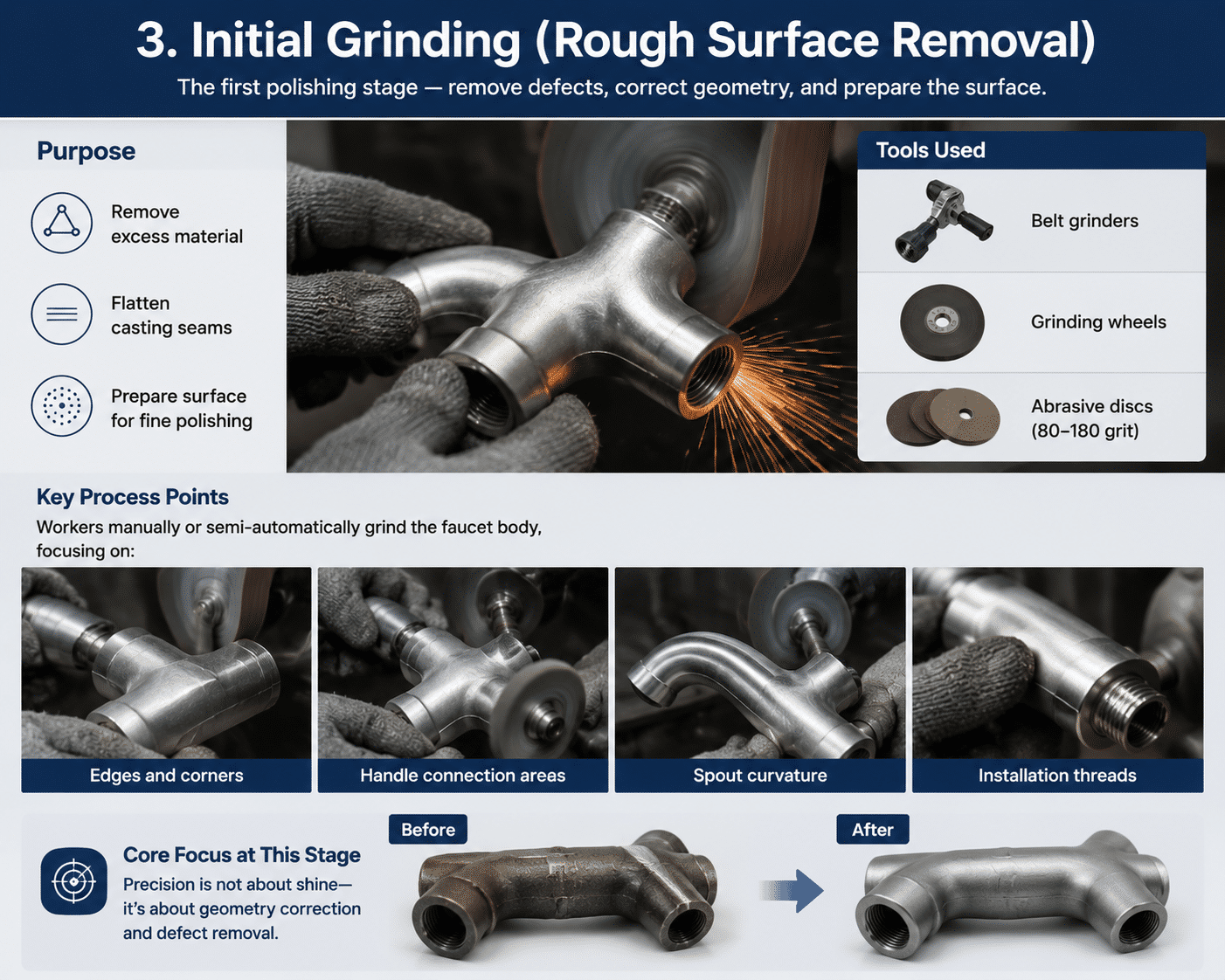
The first polishing stage is rough grinding, also known as deburring.
Purpose:
· Remove excess material
· Flatten casting seams
· Prepare surface for fine polishing
Tools Used:
· Belt grinders
· Grinding wheels
· Abrasive discs (80–180 grit)
Key Process Points:
Workers manually or semi-automatically grind the faucet body, focusing on:
· Edges and corners
· Handle connection areas
· Spout curvature
· Installation threads
At this stage, precision is not about shine—it is about geometry correction and defect removal.
4. Medium Grinding (Surface Leveling Stage)
After rough grinding, faucets enter a medium polishing stage.
Purpose:
· Remove grinding scratches
· Improve surface uniformity
· Prepare for fine polishing
Abrasives Used:
· 240–400 grit sanding wheels
· Nylon abrasive belts
· Resin polishing tools
Process Characteristics:
This stage is critical for high-end faucets because:
· It determines final surface smoothness
· Poor medium grinding cannot be fixed later
· It affects plating uniformity
Factories with strong capability invest heavily in skilled workers at this stage, because it requires experience to maintain consistent pressure and angles across complex faucet shapes.
5. Fine Polishing (Pre-Mirror Stage)
Fine polishing is where the faucet starts to show visible shine.
Purpose:
· Eliminate micro-scratches
· Achieve smooth reflective surface
· Prepare for buffing
Tools & Materials:
· 600–1200 grit polishing wheels
· Fine abrasive compounds (aluminum oxide, diamond paste)
· Cotton buff wheels
Key Focus Areas:
· Curved faucet body surfaces
· Handle joints
· Aerator outlet edges
· Decorative design lines
At this stage, the faucet should already appear semi-gloss, but not yet fully reflective.
6. Buffing (Mirror Finishing Process)
Buffing is the most visually important stage in faucet polishing.
Purpose:
· Achieve mirror-like reflection
· Remove micro-defects from fine polishing
· Enhance surface uniformity
Buffing Materials:
· White polishing compound (for high gloss)
· Green compound (for stainless steel finishing)
· Cotton cloth wheels
Process Description:
The faucet is pressed against a high-speed rotating buffing wheel. Skilled workers carefully control:
· Pressure
· Angle
· Rotation direction
Even small mistakes at this stage can cause:
· Burn marks
· Uneven gloss
· Surface waves
For export-grade faucets, multiple buffing rounds are often required.
7. Special Polishing for Complex Structures
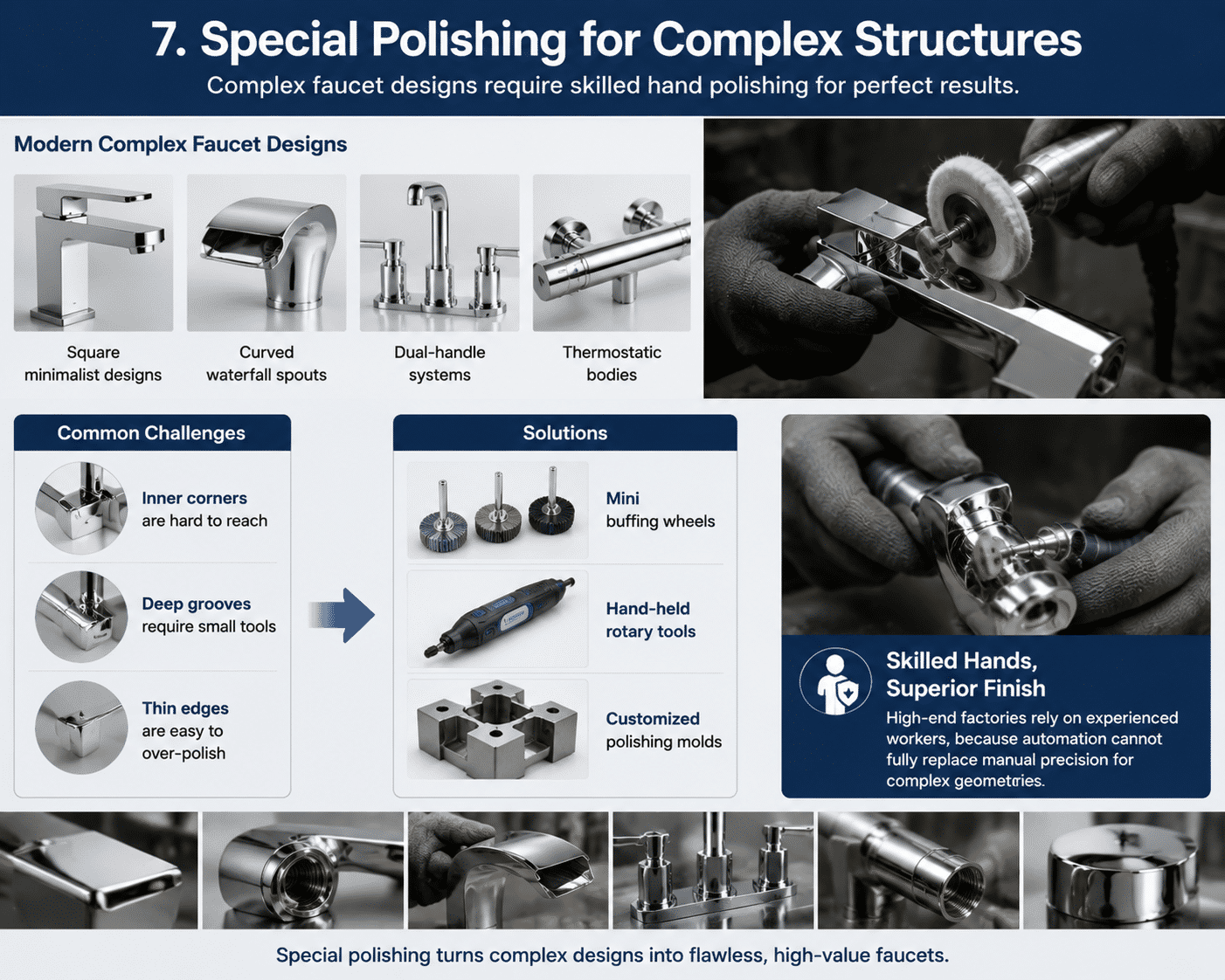
Modern faucets are no longer simple cylindrical shapes. They include:
· Square minimalist designs
· Curved waterfall spouts
· Dual-handle systems
· Thermostatic bodies
These require special hand polishing techniques.
Common Challenges:
· Inner corners are hard to reach
· Deep grooves require small tools
· Thin edges are easy to over-polish
Solutions:
· Mini buffing wheels
· Hand-held rotary tools
· Customized polishing molds
High-end factories rely heavily on experienced workers at this stage, as automation cannot fully replace manual precision for complex geometries.
8. Surface Cleaning Before Plating
Before electroplating or coating, polishing residues must be removed completely.
Cleaning Methods:
· Ultrasonic cleaning
· Alkali degreasing
· Acid activation
· Pure water rinsing
Purpose:
· Remove polishing wax and oil
· Eliminate metal dust
· Ensure plating adhesion
If cleaning is insufficient, defects such as:
· Peeling coating
· Bubbles
· Uneven plating thickness
may occur during later production stages.
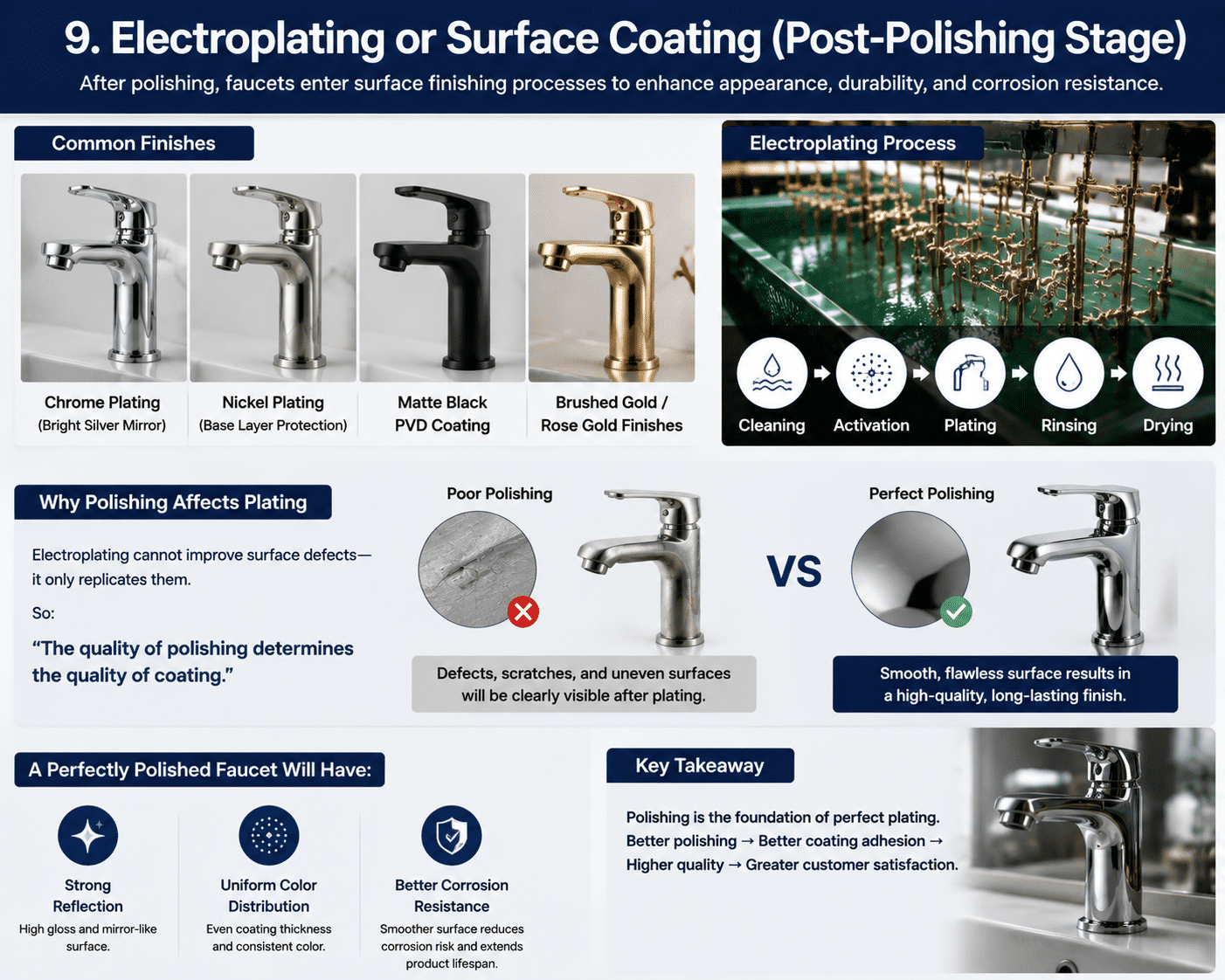
9. Electroplating or Surface Coating (Post-Polishing Stage)
After polishing, faucets enter surface finishing processes such as:
Common Finishes:
· Chrome plating (bright silver mirror)
· Nickel plating (base layer protection)
· Matte black PVD coating
· Brushed gold / rose gold finishes
Why Polishing Affects Plating:
Electroplating cannot improve surface defects—it only replicates them.
So:
“The quality of polishing determines the quality of coating.”
A perfectly polished faucet will have:
· Strong reflection
· Uniform color distribution
· Better corrosion resistance
10. Quality Inspection After Polishing
For B2B shipments, especially OEM/ODM orders, strict inspection is essential.
Inspection Criteria:
1) Visual Inspection
· No scratches
· No dull spots
· No polishing marks
· Uniform reflection
2) Surface Roughness Testing
· Measured using Ra value tools
· High-end faucets typically require ultra-low roughness
3) Adhesion Testing (after plating)
· Tape test
· Salt spray test compatibility
4) Lighting Inspection
Factories use strong LED inspection lights to detect:
· Waves
· Micro dents
· Color inconsistency
11. Common Polishing Defects and Causes
Understanding defects helps buyers evaluate supplier capability.
1) Sand Holes
Cause: poor casting quality
Impact: cannot be fully polished out
2) Uneven Gloss
Cause: inconsistent buffing pressure
Impact: visible under lighting
3) Burn Marks
Cause: excessive friction heat during polishing
Impact: surface discoloration
4) Scratch Lines
Cause: insufficient grinding stage
Impact: visible after plating
5) Orange Peel Effect
Cause: improper polishing compound usage
Impact: wavy surface reflection
12. How B2B Buyers Should Evaluate Faucet Polishing Quality
When sourcing faucets for wholesale or engineering projects, buyers should check:
1) Sample Under Strong Light
Always inspect under angled lighting to reveal defects.
2) Consistency Across Batches
One perfect sample is not enough—check production stability.
3) Edge and Hidden Areas
Many factories only polish visible surfaces; engineers should check:
· Undersides
· Inner joints
· Handle bases
4) Coating Uniformity After Use Simulation
Ask for:
· Salt spray test reports
· Durability samples
· Wear resistance results
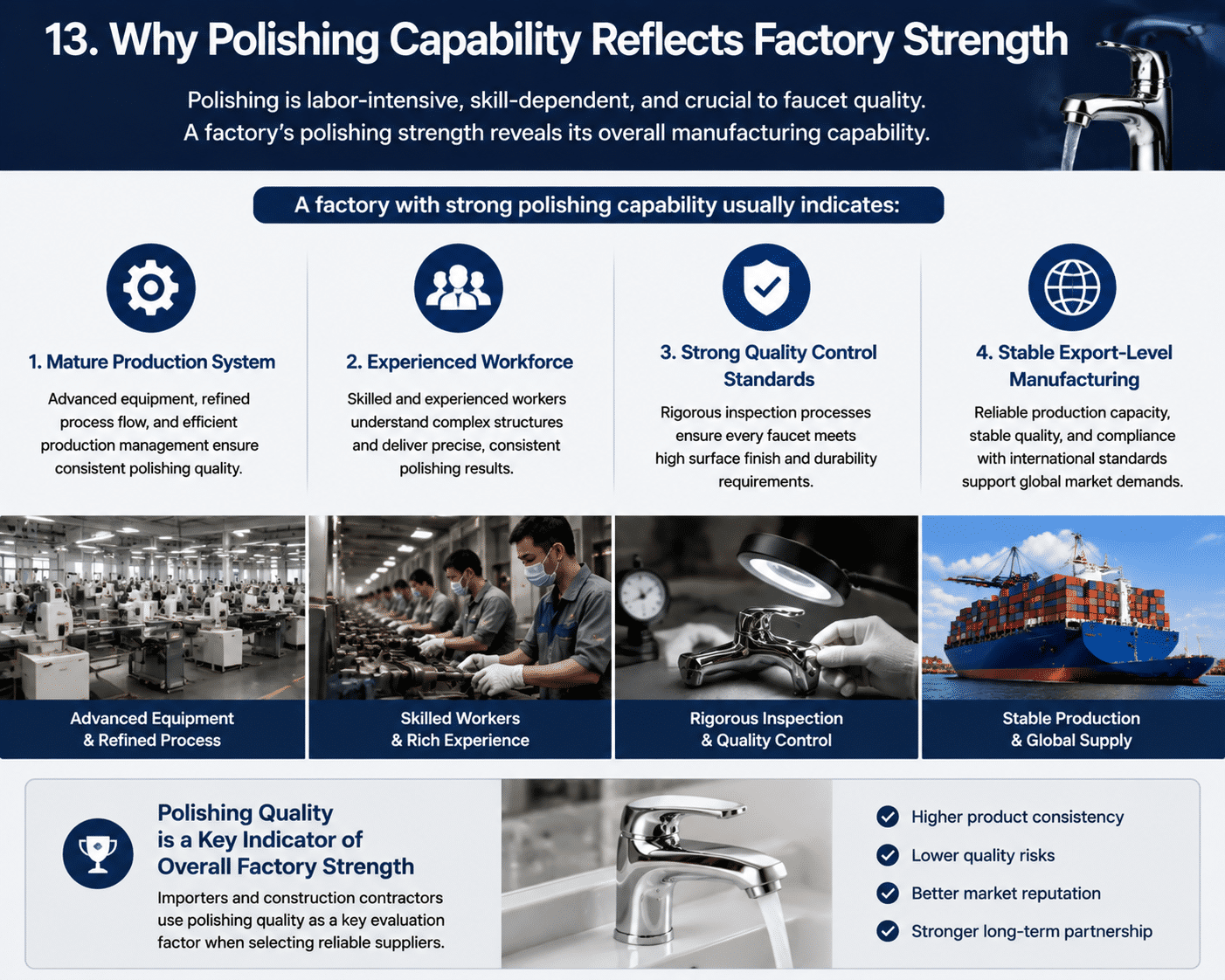
13. Why Polishing Capability Reflects Factory Strength
In the faucet manufacturing industry, polishing is one of the most labor-intensive and skill-dependent processes.
A factory with strong polishing capability usually indicates:
· Mature production system
· Experienced workforce
· Strong quality control standards
· Stable export-level manufacturing
This is why many importers and construction contractors use polishing quality as a key evaluation factor when selecting suppliers.
14. Conclusion: Polishing Defines Faucet Value
The faucet polishing process is not just a finishing step—it is a core manufacturing technology that directly determines product quality, durability, and market competitiveness.
From rough grinding to mirror buffing and final inspection, each stage plays a critical role in ensuring that the faucet meets international standards required by wholesalers, importers, and engineering contractors.
For B2B buyers, understanding this process helps you:
· Select reliable suppliers
· Reduce project risks
· Improve product consistency
· Deliver higher value to end customers
In today’s competitive sanitary ware market, precision polishing is no longer optional—it is a standard for global trade success.
Looking for a Professional Faucet Manufacturer?
We specialize in manufacturing:
· Kitchen faucets
· Bathroom faucets
· Shower systems
· Thermostatic showers
✔ Exported to 40+ countries
✔ OEM & ODM supported
✔ Minimum Order: 50 Sets
Contact us today to receive our latest product catalog and quotation.