
How Brass Faucets Are Manufactured Step by Step
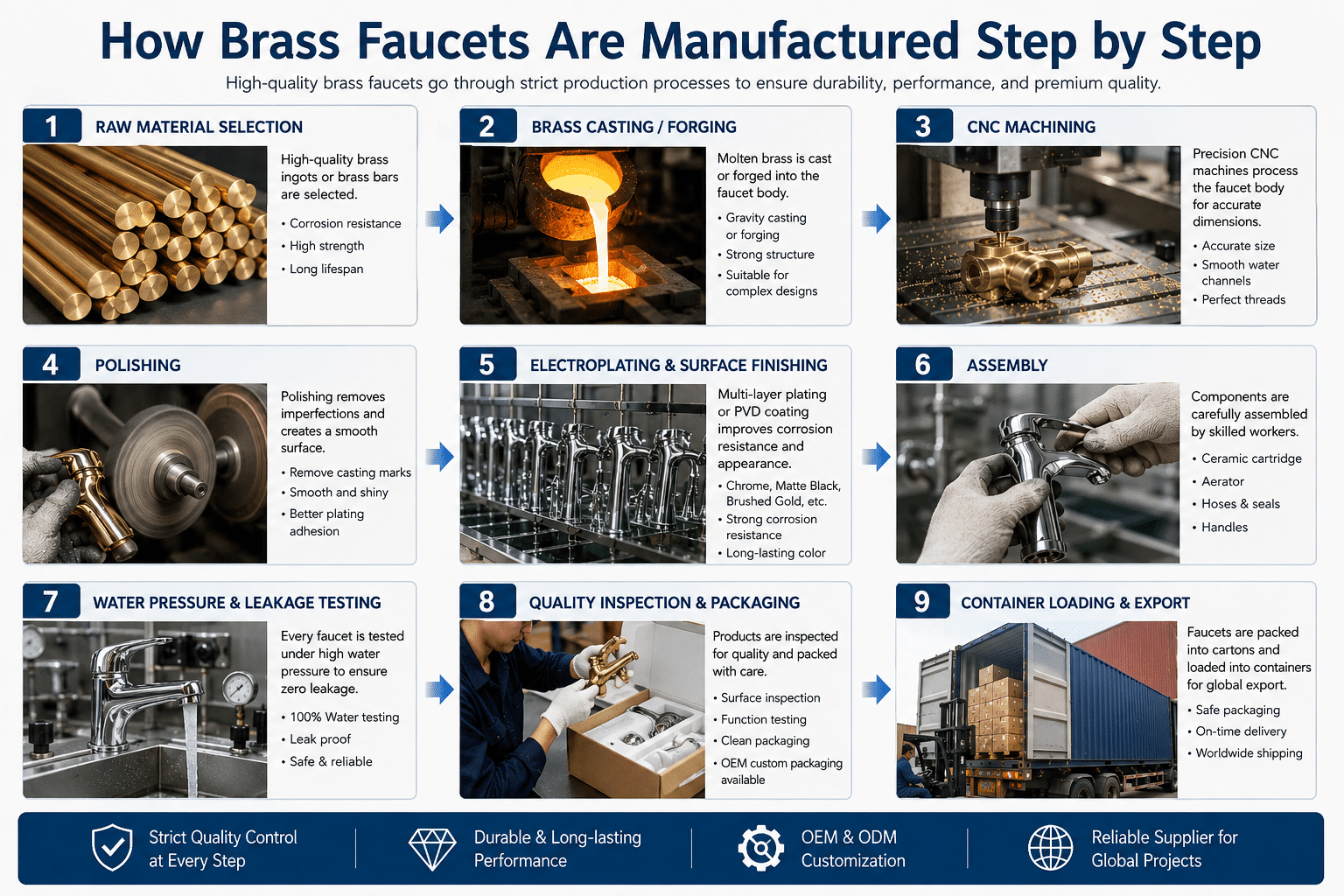 How Brass Faucets Are Manufactured Step by Step
Introduction
Brass faucets are one of the most popular choices in residential, commercial, and hospitality projects worldwide. Known for their durability, corrosion resistance, and premium appearance, brass faucets are widely used in bathrooms, kitchens, hotels, apartments, and large construction projects.
For wholesalers, importers, distributors, and construction contractors, understanding the faucet manufacturing process is essential when selecting a reliable supplier. A professional faucet factory with strict quality control can ensure long-lasting products, stable delivery, and lower after-sales risks.
In this article, we will explain how brass faucets are manufactured step by step, from raw material selection to final water pressure testing.
1. Raw Material Selection
The manufacturing process starts with high-quality raw brass materials.
Professional faucet manufacturers usually use brass ingots or brass bars with controlled copper and zinc content to ensure excellent durability and corrosion resistance. High-quality brass materials help improve:
Product lifespan
Resistance to rust and corrosion
Structural strength
Surface finishing quality
For commercial projects and wholesale markets, using certified brass materials is extremely important because low-quality raw materials can cause leakage, cracking, and plating problems in the future.
Reliable faucet factories conduct incoming material inspections before production begins.
Keywords:
brass faucet manufacturer, faucet raw materials, sanitary ware factory
2. Brass Gravity Casting or Forging
After raw material preparation, the brass is melted at high temperatures and formed into faucet bodies through gravity casting or forging.
Gravity Casting Process
Molten brass is poured into precision molds to create the faucet body shape. This process is commonly used for complex faucet designs and OEM customized products.
Advantages:
Suitable for various faucet styles
Cost-effective for large production
Good structural consistency
Brass Forging Process
Some premium faucets use forging technology, where heated brass is pressed under high pressure.
Advantages:
Higher density
Stronger structure
Better durability
Reduced internal air holes
For engineering projects and premium markets, forged brass faucets are often preferred because they provide better long-term performance.
Keywords:
brass casting process, forged brass faucet, OEM faucet production
3. CNC Machining and Precision Processing
After casting or forging, the faucet body enters CNC machining.
At this stage, advanced CNC machines precisely process:
Internal water channels
Cartridge installation holes
Thread connections
Surface shaping
Precision machining is critical because it directly affects:
Water flow performance
Leak prevention
Installation compatibility
Product lifespan
Professional faucet factories use automated CNC equipment to ensure dimensional accuracy and consistency for large-volume wholesale orders.
This step is especially important for:
Hotel projects
Apartment construction
Commercial engineering applications
Keywords:
CNC faucet machining, precision faucet manufacturing
4. Polishing and Surface Preparation
After machining, the faucet surface is still rough and requires multiple polishing procedures.
Workers carefully polish the faucet body to remove:
Casting marks
Surface imperfections
Sharp edges
Machine traces
The polishing process usually includes:
Rough polishing
Fine polishing
Manual detailing
A well-polished surface is essential because it determines the final plating quality and product appearance.
High-end faucet manufacturers pay special attention to polishing quality to achieve:
Smooth surfaces
Mirror finishes
Uniform appearance
Better coating adhesion
For luxury bathroom projects and premium wholesalers, polishing quality directly affects customer satisfaction.
Keywords:
faucet polishing process, brass faucet finishing
5. Electroplating and Surface Finishing
Electroplating is one of the most important steps in faucet manufacturing.
During this process, the polished faucet body receives multiple coating layers to improve:
Corrosion resistance
Surface hardness
Appearance durability
Color consistency
Common faucet finishes include:
Chrome
Matte Black
Brushed Gold
Gunmetal
Brushed Nickel
White and PVD finishes
PVD Coating Technology
Many premium faucet manufacturers now use PVD vacuum coating technology.
Advantages of PVD:
Stronger scratch resistance
Better corrosion protection
Longer-lasting color
Premium appearance
This technology is widely used in luxury hotels, villas, and modern commercial projects.
Professional factories strictly control electroplating thickness and coating quality to meet international standards.
Keywords:
faucet electroplating, PVD faucet coating, chrome faucet manufacturing
6. Faucet Assembly
After surface finishing, the faucet enters the assembly process.
Workers assemble:
Ceramic cartridges
Aerators
Handles
Hoses
Sealing rings
Internal components
High-quality ceramic cartridges are especially important because they determine:
Water control smoothness
Leak resistance
Service life
Reliable faucet manufacturers use strict assembly standards to ensure every component fits perfectly.
For OEM and ODM projects, customized logos, laser markings, and branded packaging are usually completed during this stage.
Keywords:
faucet assembly process, OEM faucet supplier
7. Water Pressure and Leakage Testing
Every professional faucet factory should conduct 100% water pressure testing before packaging.
This is one of the most critical quality control procedures.
The faucet is tested under water pressure to check:
Internal leakage
Cartridge sealing
Water flow performance
Structural safety
Some factories also perform:
Air pressure testing
Salt spray testing
Life cycle testing
High-pressure endurance testing
For wholesalers and engineering contractors, strict testing procedures help reduce:
Customer complaints
Installation failures
Maintenance costs
Project risks
Factories with complete testing systems are generally more reliable long-term partners.
Keywords:
faucet water pressure testing, faucet leak testing, faucet quality control
8. Quality Inspection and Packaging
Before shipment, faucets go through final quality inspection.
Inspectors check:
Surface finish quality
Logo accuracy
Accessories completeness
Packaging condition
Product functionality
Export-standard packaging is important for international transportation because it helps prevent:
Surface scratches
Transit damage
Moisture exposure
Professional faucet manufacturers usually provide:
Neutral packaging
OEM custom packaging
Barcode labels
Instruction manuals
Brand customization
For wholesale customers, stable packaging quality helps improve retail presentation and market competitiveness.
Keywords:
faucet quality inspection, OEM faucet packaging
9. Container Loading and Export
After inspection, finished products are packed into cartons and loaded into containers for export.
Experienced faucet suppliers usually have:
Stable production schedules
Export experience
International certifications
Flexible OEM services
They can support:
Wholesale distributors
Building contractors
Hotel projects
Supermarkets
E-commerce sellers
Professional export management helps ensure:
On-time delivery
Safe transportation
Stable supply chain
Keywords:
faucet export supplier, wholesale faucet manufacturer
Why Quality Control Matters in Faucet Manufacturing
For B2B buyers, quality consistency is more important than low prices alone.
A professional faucet factory should have:
Strict production standards
Advanced machinery
Experienced workers
Complete testing systems
OEM & ODM capabilities
Choosing a reliable faucet manufacturer can help wholesalers and contractors reduce risks while improving customer satisfaction and long-term business growth.
OEM & ODM Faucet Manufacturing Services
Many wholesalers and engineering companies require customized faucet solutions.
Professional faucet factories can provide:
Customized designs
Laser logo engraving
Custom colors
Packaging design
Product development
Mold customization
OEM and ODM services help brands build stronger market competitiveness.
Conclusion
The brass faucet manufacturing process involves multiple precision production steps, from raw material selection to final testing and packaging.
Every stage affects the final product quality, durability, and performance.
For wholesalers, distributors, importers, and construction contractors, choosing a professional faucet manufacturer with strict quality control is essential for long-term business success.
A reliable supplier not only provides quality products but also ensures stable delivery, OEM support, and professional export services for global markets.
If you are looking for a trusted brass faucet manufacturer for wholesale or engineering projects, working with an experienced factory can help you achieve better product quality and stronger market competitiveness.